Aircraft maintenance often involves looking beyond what is immediately visible. While visual inspections are essential, some structural or component conditions require additional examination to better understand their location, extent, or significance.
Nondestructive testing, commonly known as NDT, uses specialized methods to evaluate materials and components without damaging them during the examination. For aircraft owners, operators, and maintenance professionals, these methods can provide valuable information to support maintenance planning and repair decisions.
Straight Flight offers three NDT methods: eddy current, ultrasonic inspection, and dye penetrant testing. Understanding how they differ can help explain why selecting the appropriate method matters.
1. Why Nondestructive Testing Matters
Aircraft structures and components experience operational stresses, environmental exposure, and repeated use. Depending on the material and application, certain discontinuities or changes in condition may not be readily apparent during a visual inspection.
NDT provides additional ways to examine specific areas and investigate potential concerns. The method selected depends on the material, the suspected condition, the component’s geometry, accessibility, and the applicable inspection requirements.
NDT findings help maintenance professionals determine appropriate next steps based on the relevant approved data and work scope.
2. Eddy Current Inspection: Examining Conductive Structures
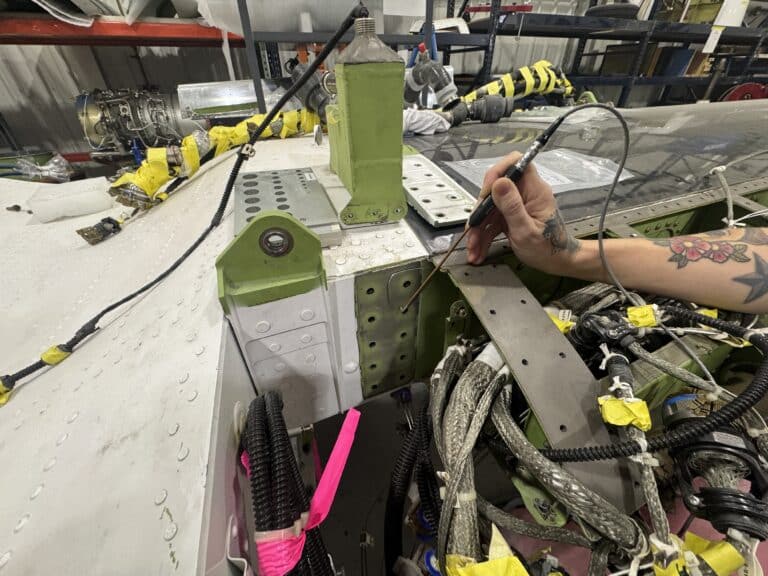
Eddy current inspection is used to detect localized surface and near-surface discontinuities in conductive aircraft structures and components.
The method can be useful when an inspection requirement calls for targeted examination of a particular area. Rather than relying exclusively on what can be seen on the surface, eddy current testing provides another way to investigate potential discontinuities in conductive materials.
The inspection approach must be appropriate for the component and the specific requirement being evaluated.
3. Ultrasonic Inspection: Looking Beyond the Surface
Ultrasonic inspection uses sound waves to evaluate material characteristics. Pulse-echo methods can support thickness verification and subsurface assessment when the component’s geometry, access, and approved data support the examination.
This can provide useful information when the inspection requirement involves material thickness or conditions that may exist beneath the surface.
As with any NDT method, the results must be interpreted within the context of the examination performed and the applicable acceptance criteria.
4. Dye Penetrant Inspection: Identifying Surface-Breaking Discontinuities
Dye penetrant inspection is a sensitive method for identifying surface-breaking discontinuities in clean, nonporous components.
The process uses a penetrant to help reveal indications that may otherwise be difficult to see. Proper surface preparation and examination procedures are important to obtaining meaningful results.
Dye penetrant inspection is intended for appropriate nonporous surfaces and is not a universal solution for every material or type of damage.
5. Choosing the Right Method Starts with the Inspection Requirement
Each NDT method serves a different purpose. Selecting one simply because it is available does not guarantee that it is suitable for a particular component or suspected condition.
The inspection requirement, material, geometry, accessibility, and applicable approved data all influence the method that can be used.
Straight Flight coordinates method selection, examination, and documentation around the aircraft’s work scope. This helps maintenance teams receive documented findings that support clear, informed decisions about the next steps.
Final Thoughts
Nondestructive testing provides valuable information when aircraft structures and components require closer examination. Eddy current, ultrasonic inspection, and dye penetrant testing each offer different capabilities, making the appropriate method dependent on the inspection requirement.
For aircraft owners and operators, working with an experienced repair station helps ensure inspection needs are evaluated in context and findings are properly documented.
Straight Flight’s NDT team can help coordinate the appropriate examination for your aircraft or component.
📞 (877)-300-9164 | 🌐 straightflight.com